
大学院生企画「Step Outside the Lab: A Casual Interdisciplinary Methodology Exchange」開催報告
2026年1月23日(金)、名古屋大学 ComoNe LOAM HALL にて、大学院生チームによるオリジナル企画「Step Outside the Lab: A Casual Interdisciplinary Methodology Exchange」が開催されました。
本イベントは、大学院共通科目「異分野コラボレーションスキル演習Ⅱ」の集大成として実施されたもので、同科目を受講する大学院生4名がチームとなって、企画立案から運営までを主体的に担いました。
授業の中ではまず、「名古屋大学大学院生の研究生活における課題」について検討を行い、
・日本人学生と留学生の交流が少ないこと
・異分野間での研究交流の機会が限られていること
という点に着目しました。
さらに議論を深める中で、
「これまでの異分野交流は、研究“成果”の共有に重点が置かれてきた。一方で、研究に固有の“視点”や“アプローチ”そのものを共有する機会は少ないのではないか」
という問いに行き着き、「方法論」に焦点を当てた交流イベントという本企画のアイディアが生まれました。
学生たちは、プロジェクトチャーターによる価値・目的の明確化、プロトタイプによる検証、WBSによる役割分担、ガントチャートによる進行管理など、授業で学んだプロジェクトマネジメントの手法を実践的に活用しながら、構想を具体的なイベントへと発展させていきました。
普段何気なく参加しているイベントが、どのような設計と配慮のもとに成り立っているのかを、企画する側として実感できる経験にもなったことと思います。
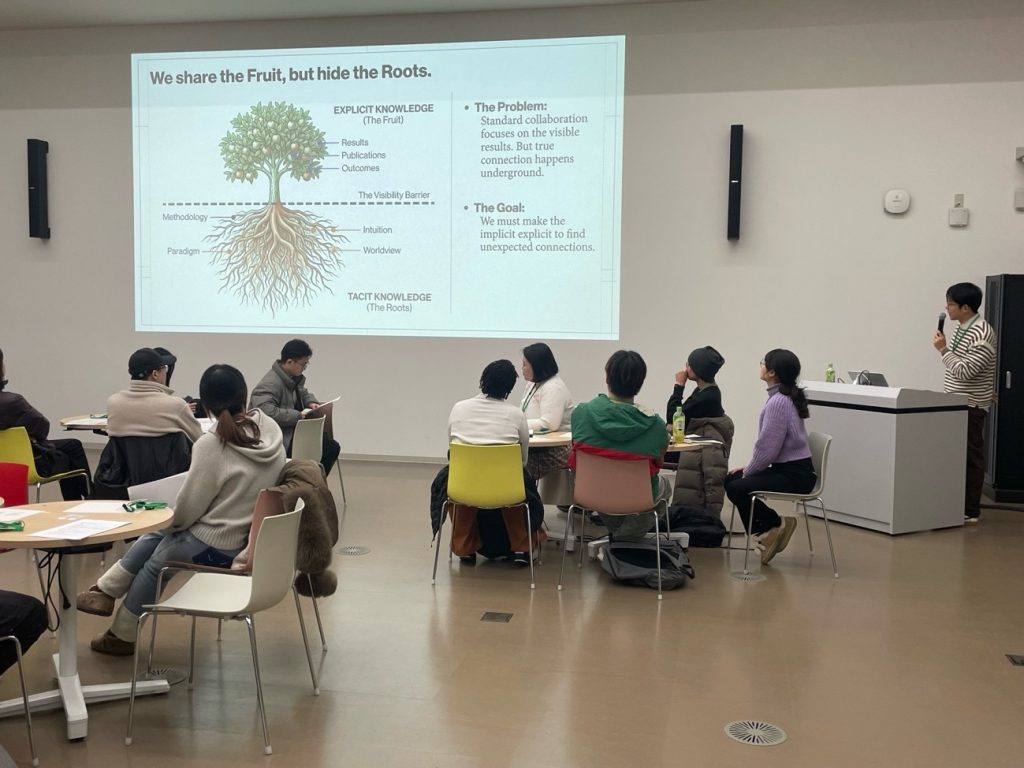
イベント当日は14名の大学院生が参加しました。企画学生によるイベントの趣旨説明や事例紹介のあと、参加者は3〜4名ずつの少人数グループに分かれ、チームが独自に開発した「How I Think Map」というテンプレートを用いて、自身の分野における思考の特徴や研究スタイルを整理したうえで対話に臨みました。
対話のきっかけとして、「時間」「食べ物」「ノイズ」「家」「バランス」「境界」といった身近なテーマから一つを選び、それが自分の分野の方法論とどのようにつながるのかを考えました。研究を現実世界と結びつけ、少し身近に感じられるようにすることが狙いです。
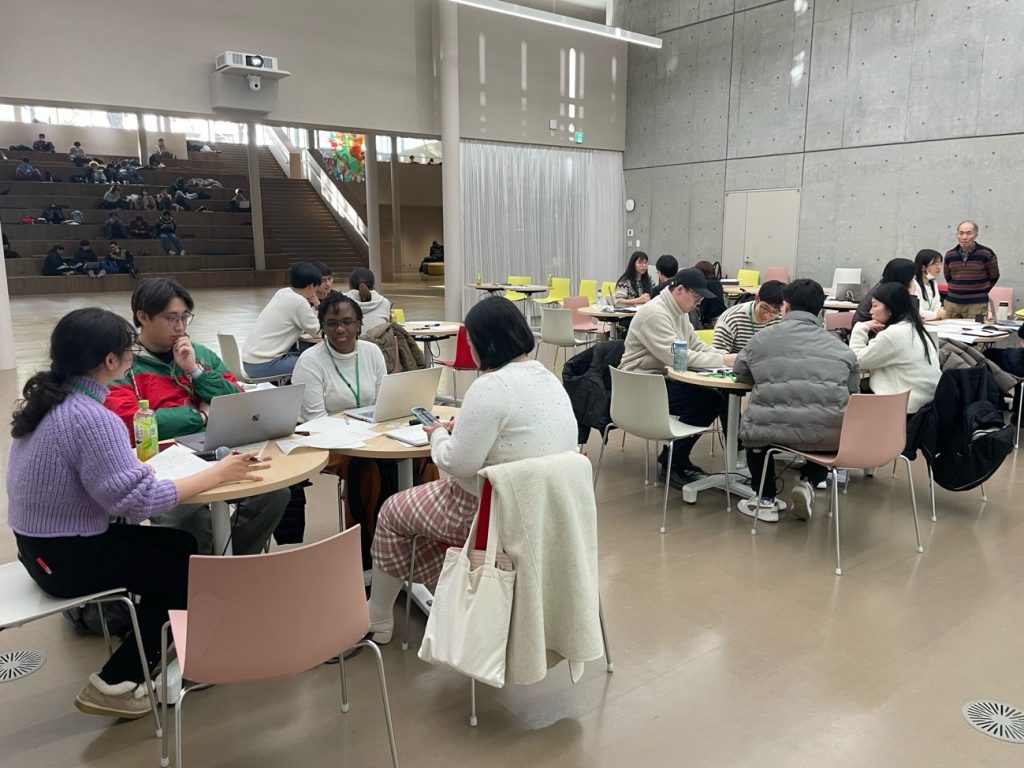
会場では、どのグループでも会話が途切れることなく続き、予定していた時間いっぱいまで、互いの考え方やアプローチを熱心に語り合う姿が見られました。専門や立場の異なる参加者同士が、初対面でありながらも自然に対話を深めていく様子は、「研究成果」ではなく「考え方」に焦点を当てるという本企画のねらいが、実際によく機能していたことがうかがえます。参加者にとって、自身の研究をあらためて見つめ直すきっかけとなったのではないでしょうか。
以下は、企画チームの学生からのコメントです。
―――――――――――
・NONAKA Yuta/M1/Medicine
Discussing the goals, budget, and content entirely from scratch with members from different disciplines and nationalities, and moving forward with the planning and operation, was a very valuable learning experience.
In addition, spending time thinking about how to encourage students to participate gave me an opportunity to reflect on what kind of event can be both meaningful and enjoyable for them.
・WANG Yibin/D2/Mathematics
If this theme is held again in the future, or if there are plans to continue developing activities around this theme, I believe it would be better to divide it into two stages.
Because people tend to have cognitive inertia (perhaps due to having participated in too many similar events), I feel that some participants did not fully understand the true purpose of this event. They began by talking about their own research without reflecting on the underlying logic and worldview behind their work.
If the event is organized again, I suggest that the first stage (online) focus on explaining the purpose of the event and providing examples, in order to break participants’ habitual ways of thinking and encourage deeper reflection. After this period of thinking and internalization, the second stage (offline) could then be used for discussion and exchange.
・LIU Xinzi/D3/Medicine
This course offered a valuable opportunity to develop interdisciplinary communication and collaboration skills through a combination of theoretical learning and hands-on practice. I was able to strengthen my ability to communicate effectively, coordinate tasks, and collaborate toward shared goals. Such comprehensive skill training is a rare and meaningful experience during my PhD studies.
I also benefited greatly from collaborating with the other three team members, each of whom brought distinct strengths to the project. Yuta san excelled in communication and managing project progress, Lyu san demonstrated strong skills in planning and synthesizing ideas, and Wang san was strong in abstract and theoretical thinking. Through our complementary collaboration, the project became more comprehensive and well-structured.
・LYU Pingxue/D3/Science
Through this Interdisciplinary Collaboration Skills course, I learned how to develop a project truly from zero to implementation. Starting from a big idea and gradually turning it into a real event taught me the importance of not only dreaming big, but also applying the WISE framework to carry out a project strategically and effectively.
Using tools like a Gantt chart helped us manage the workflow, track progress, and coordinate responsibilities within the team. This experience showed me how essential clear planning and communication are in collaborative projects, especially across different fields.
These skills will be extremely valuable for my future research and work. I am also very grateful to my three teammates — we had great teamwork, supported each other throughout the process, and truly enjoyed both the course and organizing this event together.
Student-Led Event Report
“Step Outside the Lab: A Casual Interdisciplinary Methodology Exchange”
On Friday, January 23, 2026, the student-led event “Step Outside the Lab: A Casual Interdisciplinary Methodology Exchange” was held at ComoNe LOAM HALL, Nagoya University.
This event was organized as the culmination of the graduate common course “Interdisciplinary Collaboration Skills II.” Four graduate students enrolled in the course formed a team and took full responsibility for the project, from planning to on-site operation.
In the course, the students first examined challenges in the research lives of graduate students at Nagoya University and identified two key issues:
・limited interaction between Japanese and international students, and
・few opportunities for research exchange across disciplines.
As discussions deepened, the team arrived at the following question:
“Most existing interdisciplinary exchanges focus on sharing research outcomes. But are there enough opportunities to share the perspectives and approaches that underlie each field?”
This led to the core idea of the event: an exchange centered on methodology—how people think and approach research—rather than on results.
While developing the project, the students applied the project management methods learned in class, including clarifying values and goals through a project charter, testing ideas through prototypes, assigning roles with a Work Breakdown Structure (WBS), and managing progress with a Gantt chart. Through this process, they transformed their initial concept into a concrete event. It also gave them firsthand insight into how events that we usually attend casually are carefully designed and implemented from behind the scenes.
On the day of the event, 14 graduate students participated. After an introduction by the organizing team outlining the purpose of the event and presenting examples, participants were divided into small groups of three to four members. Using a template developed by the team called the “How I Think Map,” they first organized the characteristics of their own disciplinary thinking and research styles before engaging in dialogue.
As a starting point for discussion, each group selected one familiar theme—such as time, food, noise, home, balance, or boundaries—and considered how the methods of their own fields connected to that theme. The aim was to link research to everyday experience and make it feel more accessible.
Throughout the venue, conversations in every group continued without pause, filling the entire allotted time as participants enthusiastically shared their ideas and approaches. The way students from different disciplines and backgrounds naturally deepened their conversations—despite meeting for the first time—suggested that the event’s focus on “ways of thinking” rather than “research results” was functioning effectively. For many participants, this experience may have become an opportunity to reconsider their own research from a fresh perspective.
Below are comments from the organizing team members:
⸻
・NONAKA Yuta/M1/Medicine
Discussing the goals, budget, and content entirely from scratch with members from different disciplines and nationalities, and moving forward with the planning and operation, was a very valuable learning experience.
In addition, spending time thinking about how to encourage students to participate gave me an opportunity to reflect on what kind of event can be both meaningful and enjoyable for them.
・WANG Yibin/D2/Mathematics
If this theme is held again in the future, or if there are plans to continue developing activities around this theme, I believe it would be better to divide it into two stages.
Because people tend to have cognitive inertia (perhaps due to having participated in too many similar events), I feel that some participants did not fully understand the true purpose of this event. They began by talking about their own research without reflecting on the underlying logic and worldview behind their work.
If the event is organized again, I suggest that the first stage (online) focus on explaining the purpose of the event and providing examples, in order to break participants’ habitual ways of thinking and encourage deeper reflection. After this period of thinking and internalization, the second stage (offline) could then be used for discussion and exchange.
・LIU Xinzi/D3/Medicine
This course offered a valuable opportunity to develop interdisciplinary communication and collaboration skills through a combination of theoretical learning and hands-on practice. I was able to strengthen my ability to communicate effectively, coordinate tasks, and collaborate toward shared goals. Such comprehensive skill training is a rare and meaningful experience during my PhD studies.
I also benefited greatly from collaborating with the other three team members, each of whom brought distinct strengths to the project. Yuta san excelled in communication and managing project progress, Lyu san demonstrated strong skills in planning and synthesizing ideas, and Wang san was strong in abstract and theoretical thinking. Through our complementary collaboration, the project became more comprehensive and well-structured.
・LYU Pingxue/D3/Science
Through this Interdisciplinary Collaboration Skills course, I learned how to develop a project truly from zero to implementation. Starting from a big idea and gradually turning it into a real event taught me the importance of not only dreaming big, but also applying the WISE framework to carry out a project strategically and effectively.
Using tools like a Gantt chart helped us manage the workflow, track progress, and coordinate responsibilities within the team. This experience showed me how essential clear planning and communication are in collaborative projects, especially across different fields.
These skills will be extremely valuable for my future research and work. I am also very grateful to my three teammates — we had great teamwork, supported each other throughout the process, and truly enjoyed both the course and organizing this event together.
今までの活動報告/Program Reports
【博士機構活動報告】2024年度MNS事業Boot Camp 実施報告/2024 Boot Camp initiated by MNS Program Report
博士機構活動報告vol.2を掲載しました。/ We posted DEC Activity Report vol.2.
博士機構活動報告vol.3を掲載しました。/ We posted DEC Activity Report vol.3
博士機構活動報告vol 4 を掲載しました。/ We posted DEC Activity Report vol.4
博士機構活動報告vol 5 を掲載しました。/ We posted DEC Activity Report vol.5
博士機構活動報告vol 6 を掲載しました。/ We posted DEC Activity Report vol.6
博士機構活動報告vol 7 を掲載しました。/ We posted DEC Activity Report vol.7












 お問い合わせ